
Why the NO had nothing to do with your product

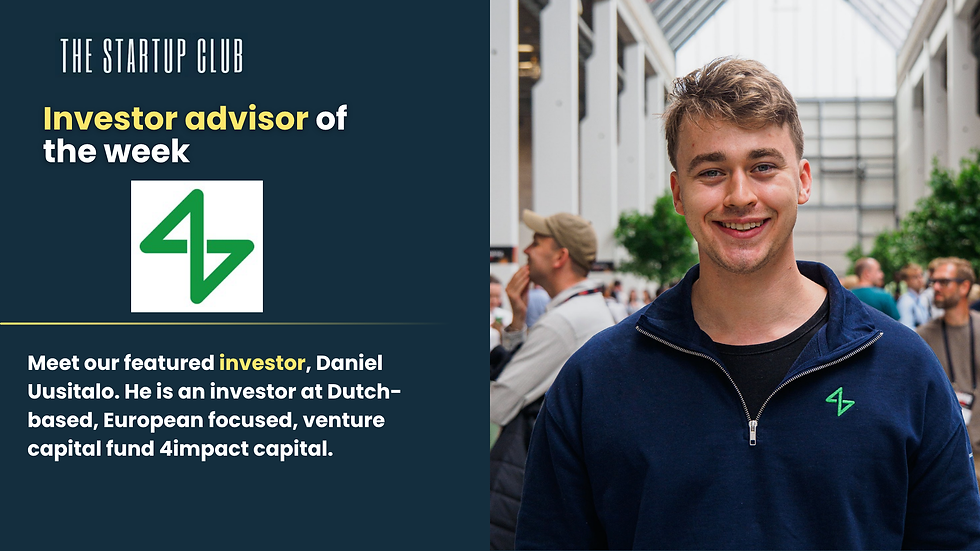
By Daniel Uusitalo, Investor at 4impact capital
The passes I feel worst about are the ones where the founder wrote back a week later with a rebuilt deck. Nothing in the deck was the problem. The round did not fit our fund’s model, and sometimes explaining is viewed as too abstract of a reason for the pass.
A large share of early-stage passes are settled before anyone forms a real and truly informed opinion about your company. They are settled by baseline fund arithmetic, and the arithmetic is boring, fixed, yet completely knowable. Here it is, worked through for an imaginary €100M fund.
What a €100M fund can actually do
Management fees of roughly two percent a year over a ten-year fund life, plus costs, mean about €80M actually reaches companies. Call it half for first cheques and half held in reserve for follow-on rounds, so €40M for new positions. Spread across 28 companies, the average first cheque lands around €1.4M in this example.
If the fund targets roughly ten percent ownership at entry, a €1.4M cheque implies an entry valuation around €14M post-money. While this may sound counterintuitive, this conversation is not always about how much confidence the VC has in your business plan.
At a €6M post-money, ten percent costs €600k, and the fund has spent one of its 28 slots on half of what a slot is built to carry. At €30M, ten percent costs €3M, double the cheque. So, this fund realistically enters somewhere between the two. Outside that range, the answer is likely to either be a no, or you may receive a proposal that does not fit your expectations. This is less about your prospects, and more about how the fund’s strategy is constructed. These ratios differ fund to fund, such as via minimum equity stake targeted, but the direction of the logic generally does not deviate significantly.
Why ownership is the whole game
A €100M fund is typically underwriting to about three times its capital, so €300M back. Venture outcomes are concentrated enough that in practice the best company in the portfolio has to return something close to the entire fund on its own. While this may not always happen, it practically needs to be the target.
Entry at ten percent does not stay ten percent. Across a seed, a Series A, a Series B and a couple of option pool refreshes, the fund can lose half of it in a moderately successful scenario, holding perhaps seven to eight percent at exit if it continuously defends the position with reserves. Now the sums: seven percent of a €1.4B exit is about €100M, and the fund is made whole from one company. Four percent of the same exit is €56M, and the same company now needs to be worth €2.5B for the fund to reach the same place of safety.
Three points of entry ownership move the exit a fund needs by more than a billion euros. That is why an investor who genuinely likes you will still pass on a €400k allocation in a round that is mostly spoken for. They are not necessarily sceptical. They simply cannot build a fund out of that position.
Three passes that are not about you, two that are
The structural ones.
Round shape: too small of a round, allocation gone, or a valuation outside the bands above.
Timing: you are raising faster than what their process can meet, or their fund is late in its deployment period.
Mandate: geography, stage, sector, or in our case the regulatory scopes, such as being an Article 9 fund.
The more practical ones for you as a founder.
No or insufficient evidence of pull: nobody paid, not enough renewals, or that the product simple does not provide its users with enough value to validate a purchase decision going forward, such as after an initial pilot.
The market is or is becoming saturated.
And team, the one that more rarely gets addressed. When making investments as a VC fund, more often than not, you won’t be able to get to know the team well enough to know for certain, that there is some degree of founder-market fit. We need to rely on concepts like “serial founder” or history of successful execution, to gain conviction in you as founders. Yet this on its own is rarely enough. We need the skillsets in the founding team to be complementary.
Fund practicals vs. valuable feedback.
So ask which one it was
When the pass arrives, reply with one line: was that a fit constraint or a conviction call? Most investors answer honestly when prompted, because admitting to arithmetic costs nothing and it stops both sides from wasting valuable time.
Then treat the answers differently. An arithmetic no is a scheduling problem: send a short update every couple of months and come back when your round shape matches their model. A conviction no is worth revisiting only once a fact has changed. Not a new narrative or positioning update. A fact.
The reason passes come out vague is not malice. Saying our model does not work at your round size does not come naturally to us, so investors have a habit of softening it, and the softened version can read as “your company is not good enough”. I think we as investors in general have a long way to go in this regard. A founder who is annoyed with disappointing news may lose an afternoon. A founder who spends three weeks on and off rebuilding a deck that was already fine loses focus and three weeks of runway, and runway is the one thing at this stage that never comes back.
About the author
Daniel Uusitalo is a Finnish venture capital investor backing early-stage, digital-first and impact-focused companies across Europe, with an emphasis on the Nordics. He covers the Nordics at 4impact capital, a Netherlands-based impact VC, and was previously an investor at Helen Ventures, an early backer of Virta, Enspired, Gradyent and Voltfang, among others.


Comments